


We’ve all been there.
You sit down at your desk on a Monday morning, coffee in hand, ready to follow up with the people who visited your church over the weekend. You open your church management software, and instead of a clear path forward, you’re met with a wall of tabs, complex menus, and a dashboard that feels more like a flight simulator than a tool for ministry.
By the time you’ve navigated three sub-menus just to find a phone number, your focus is gone. The "powerful" system that was supposed to help you stay organised is now the very thing slowing you down.
In the world of church administration, there is a growing conversation about simple church software. Why? Because we’re beginning to realise that when it comes to technology, more isn't always better. In fact, for most UK churches, "more" is exactly what’s killing our productivity.
The Problem with the "Kitchen Sink" Approach
For years, the trend in church management software UK has been towards "all-in-one" platforms. These systems promise to do everything: manage your accounting, run your website, track your lighting cues, and maybe even make your morning tea.
It sounds efficient on paper. But in reality, this "bloat" creates a significant burden.
When a system tries to do everything, it often does nothing particularly well. Features you’ll never use clutter the interface, making the tasks you actually do every day: like following up with a new family: harder than they need to be.
This isn't just an inconvenience. It’s a productivity killer. Research shows that every time we have to navigate a complex interface or pause to remember how a system works, we lose "cognitive momentum." For a busy pastor or a part-time administrator, those lost minutes add up to hours of wasted time every single week.
Why Generic CRMs Fall Short for UK Churches
Many churches in the UK have tried to adapt generic business CRM (Customer Relationship Management) systems. On the surface, it makes sense. These tools are powerful and highly customisable.
However, they were built for sales teams chasing leads, not for church teams welcoming people into a community.
As a result, UK churches often find themselves paying high "consultancy fees" just to get these systems to speak the language of church life. Instead of focusing on frontline ministry, time and money are diverted into managing the database itself. In a volunteer-led organisation, this complexity is a recipe for burnout.

The Volunteer Barrier
The heart of every UK church is its volunteers. Whether it’s the welcome team, the youth leaders, or the person managing the coffee rota, these people are giving their time because they love the church, not because they want to learn a complex piece of software.
When a system is bloated, volunteers simply stop using it.
They’ll go back to what they know: paper scraps, personal WhatsApp groups, and spreadsheets hidden on their own laptops. This creates "data silos": pockets of information that the rest of the team can’t see.
When information is scattered, people fall through the cracks. A visitor’s prayer request gets forgotten in a text thread. A new family's contact details stay tucked away in someone’s pocket. Simple church software removes this barrier by being intuitive. If a volunteer can use a basic smartphone app, they should be able to use your church system. No "bootcamp" or 50-page manual required.
The Rise of the Minimalist Interface
The most effective tools in 2026 are the ones that get out of the way.
There is a quiet movement happening where church leaders are choosing simple church software that focuses on the core essentials of church life:
- Following up visitors with a human touch.
- Managing events without the ticketing headache.
- Keeping people’s stories together in one place.
When you remove the 80% of features you don’t need, the 20% you use every day becomes remarkably powerful. You gain a sense of calm. You know exactly what needs to be done next. There’s no more "search and rescue" for contact details.
Restoring Focus to Ministry
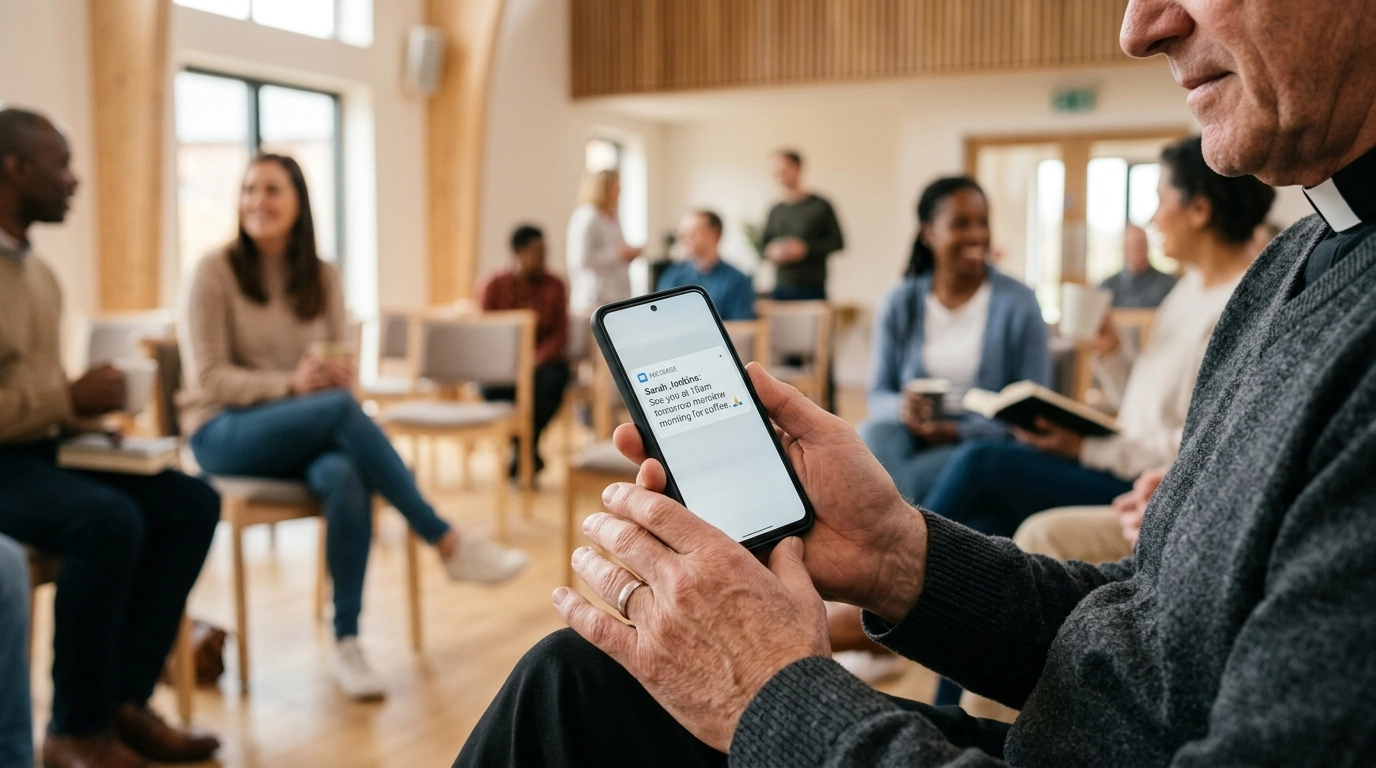
The ultimate goal of any technology in the church should be to help you spend less time on the computer and more time with people.
When your system is simple, it stops being a "task" on your to-do list and starts being a partner in your ministry. You aren’t "managing a database"; you’re caring for your people.
Imagine a Monday morning where you open your dashboard and see a clear list of three people to call, two emails to send, and one volunteer to thank. Everything is right there. No clutter. No noise. Just the work of connection.
This is the promise of a calmer approach to technology. It restores your focus to what truly matters: building a community where everyone feels seen and known.
How to Audit Your Current System
If you’re feeling overwhelmed by your current tools, it might be time for a simple audit. Ask yourself these three questions:
- Do my volunteers actually use it? If the answer is "only after I nag them," the system might be too complex.
- How many clicks does it take to find a person's story? If you have to navigate through multiple layers, you’re losing time to bloat.
- Is it built for the UK? Many systems use language and pacing that feels foreign to UK church life. If it feels "salesy," it’s probably not the right fit.
A Calmer Way Forward with Church Loop
At Church Loop, we built our platform specifically to solve the problem of bloat.
We saw too many UK churches struggling with systems that were either too complicated or completely generic. We wanted to create something different: a place that feels warm, human, and unmistakably yours.
Church Loop brings together your visitor follow-up, people profiles, and event management into one calm flow. It’s designed for real church teams: pastors who are juggling a million things, administrators who want clarity, and volunteers who just want to help.
By focusing on the essentials, we’ve created a space that helps you stay connected without the chaos. No unnecessary features. No corporate jargon. Just a simple, purpose-built tool to help you keep people from falling through the cracks.

Conclusion
The "everything plus the kitchen sink" era of church software is coming to an end. In its place, a more thoughtful, minimalist approach is taking root.
Choosing simple church software isn't about doing less; it's about doing the things that matter with more intentionality and less stress. It’s about creating a culture where technology serves the mission, rather than the mission serving the technology.
If you’re ready to leave the bloat behind and find a calmer way to manage your church, we’d love to help you get started.
Simple, not complicated. Clear, not overwhelming.
That is the future of church management.
Ready to simplify your follow-up? Explore how Church Loop can help your team stay connected without the chaos.